

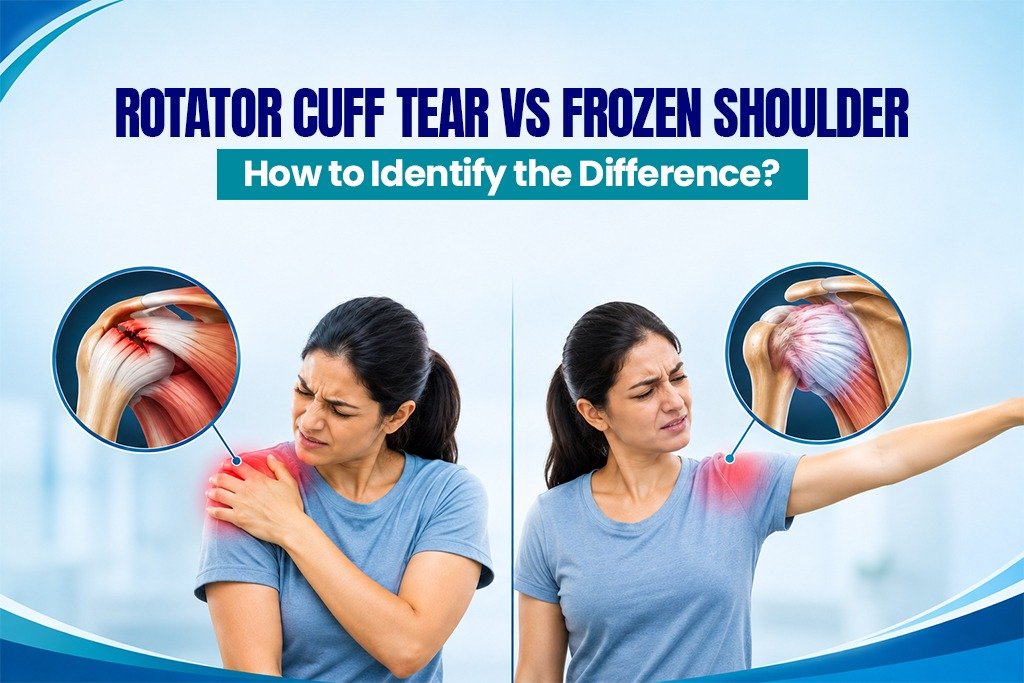
Shoulder pain that limits your arm movement can be worrying, and two conditions are often confused with each other: a rotator cuff tear and a frozen shoulder. Both can cause pain, disturb sleep, and make everyday tasks harder. However, they are different conditions and may require different treatment approaches.
Knowing how these conditions differ can help you ask the right questions and seek appropriate care early. This guide explains their symptoms, how doctors distinguish between them, and what treatment options are available. It cannot replace a medical examination, but it can help you understand when to get your shoulder checked.
Understanding the Two Conditions
What Is a Rotator Cuff Tear?
The rotator cuff is a group of four muscles and tendons around the shoulder joint. They help keep the upper arm bone centred in the socket and allow you to lift and rotate your arm. A tear means one or more of these tendons are partially or completely damaged. It may develop gradually due to wear and tear or occur suddenly following an injury such as a fall.
What Is Frozen Shoulder?
Frozen shoulder (adhesive capsulitis) occurs when the capsule, the soft tissue surrounding the shoulder joint, becomes inflamed, thickened, and tight. The shoulder gradually becomes painful and stiff, restricting movement. It is more common between 40 and 60 years of age and is seen more frequently in people with diabetes or thyroid problems. It may also develop after a period of reduced shoulder movement.
Key Differences at a Glance
| Feature | Rotator Cuff Tear | Frozen Shoulder |
| Main problem | Pain and weakness | Pain and stiffness |
| Movement | Active movement may be more limited than passive movement | Both active and passive movement are restricted |
| Onset | Sudden after injury or gradual | Usually gradual |
| Night pain | Common, especially when lying on the affected side | Common, particularly during the painful phase |
| Weakness | May be prominent | Often related to pain and reduced use |
| Typical age | More common with increasing age, but can occur earlier after injury | Commonly 40 to 60 |
| Scan findings | MRI or ultrasound may show tendon damage | X-rays are often normal; diagnosis is mainly clinical |
These are general patterns. Some patients have features of both conditions, and both can occur together. This is why a proper examination is important.
1. Active vs Passive Movement: The Most Useful Clue
Doctors often check two types of shoulder movement:
- Active movement: How far you can lift your arm on your own.
- Passive movement: How far someone else can move your arm while you relax.
In a rotator cuff tear, you may have difficulty lifting your arm yourself because of tendon weakness or pain. However, when the doctor moves your arm for you, the movement may be relatively better preserved.
In a frozen shoulder, both active and passive movement are restricted. The joint capsule becomes tight, so even when someone gently moves your arm, it cannot move through its normal range.
2. Weakness vs Stiffness
If your main complaint is that your arm feels weak, you struggle to lift a bag, or your arm tires quickly, a rotator cuff problem may be responsible.
If your main complaint is that the shoulder feels locked or stuck, and you cannot reach behind your back or rotate your arm outwards, frozen shoulder may be more likely.
However, pain and weakness can occur in both conditions, so an examination is necessary to identify the cause.
3. How the Pain Starts
A rotator cuff tear may start suddenly after a fall or heavy lift, or develop gradually due to years of repetitive overhead activity and tendon degeneration.
Frozen shoulder usually develops gradually without a specific injury. Pain may increase initially, followed by increasing stiffness and restricted movement.
4. The Stages of Frozen Shoulder
Frozen shoulder commonly progresses through three phases:
- Freezing: Increasing pain and gradual loss of shoulder movement.
- Frozen: Pain may gradually reduce, but stiffness and restricted movement are often at their worst.
- Thawing: Shoulder movement slowly begins to return.
The overall course can take many months and sometimes longer. A rotator cuff tear does not follow this pattern. Complete tendon tears generally do not heal back to the bone on their own.
5. Which Movements Hurt?
With a rotator cuff tear, pain is often triggered by lifting the arm, reaching overhead, or carrying objects.
With frozen shoulder, pain and restriction may occur at the end range of several movements, such as rotating the arm, reaching behind the back, or lifting it to the side.
6. Night Pain
Both conditions can disturb sleep.
In a rotator cuff tear, pain is often worse when lying on the affected shoulder. In frozen shoulder, night pain is also common, particularly during the painful early phase, and may occur in different sleeping positions.
How Doctors Tell Them Apart
A shoulder pain doctor in Jaipur will usually follow these steps:
- Medical history: Understanding when and how the pain began, whether there was an injury, and whether you have conditions such as diabetes or thyroid disease.
- Physical examination: Checking active and passive movement, shoulder strength, and performing specific tests to assess the rotator cuff.
- X-ray: To check for arthritis, bone spurs, or other bone-related problems. X-rays are often normal in frozen shoulder.
- MRI or ultrasound: These imaging tests can help identify a rotator cuff tear and assess its size and extent when clinically necessary.
A scan may also show a rotator cuff tear in someone who has a stiff shoulder. Your doctor interprets imaging findings alongside your symptoms and physical examination. Some tears seen on scans may not cause symptoms, particularly in older adults.
Treatment: How Different Are the Approaches?
Frozen Shoulder
Treatment is usually non-surgical and may include:
- Pain-relief medicines, as advised by your doctor.
- Physiotherapy and gentle stretching exercises.
- Heat application and regular home exercises, when appropriate.
- Injections in selected patients.
- A procedure or surgery may be considered in a small number of patients whose stiffness persists despite appropriate treatment.
Patience and regular, guided exercises are important. Forcing the shoulder through painful movements or keeping it completely immobile for prolonged periods may interfere with recovery.
Rotator Cuff Tear
Treatment depends on the tear size, your age, activity level, overall health, and how much the shoulder affects your daily life.
- Non-surgical: Activity modification, medicines, physiotherapy to improve shoulder movement and strengthen supporting muscles, and injections in selected cases.
- Surgical: May be discussed for large or complete tears, certain injuries in active individuals, or when appropriate non-surgical treatment has not provided sufficient relief.
Rotator cuff surgery in Jaipur is commonly performed using arthroscopy (keyhole surgery), where small incisions are made and a tiny camera guides the surgeon in repairing the torn tendon back to the bone. Your surgeon will explain whether this approach is suitable for your particular tear.
For anyone searching for rotator cuff treatment in Jaipur, the starting point is always a proper diagnosis, since different shoulder conditions require different treatment approaches.
Why a Wrong Guess Can Cost You Time
Self-diagnosis and inappropriate home treatment may delay recovery:
- Aggressive stretching or strengthening exercises without proper assessment may aggravate shoulder pain.
- Keeping a frozen shoulder completely immobile for a prolonged period may increase stiffness.
- Some rotator cuff tears may enlarge over time and become more difficult to repair.
- Shoulder pain can also originate from the neck, arthritis, or, less commonly, the heart or other organs, which require different medical attention.
If your shoulder pain lasts more than a few weeks, it is wise to get examined rather than guess the cause.
How to Choose a Rotator Cuff Specialist in Jaipur
When looking for a rotator cuff specialist in Jaipur, you can check for:
- Valid registration and recognised orthopedic qualifications.
- Experience with shoulder conditions and arthroscopic procedures.
- Clear explanations of your diagnosis, scan findings, and treatment options.
- Willingness to discuss non-surgical treatment when appropriate.
- Suitable hospital and rehabilitation facilities.
- Reliable follow-up care after treatment.
A second opinion is always reasonable before surgery.
When Should You See a Doctor?
Book an appointment if you have:
- Shoulder pain lasting more than a few weeks.
- Night pain that disturbs your sleep.
- Weakness or difficulty lifting your arm.
- Increasing stiffness that limits dressing, combing your hair, or reaching behind your back.
- Pain or weakness after a fall or injury.
Seek urgent medical attention for sudden severe pain, visible deformity after an injury, or if you cannot move your arm at all. Chest pain or breathlessness accompanied by shoulder or arm pain requires emergency medical attention.
Frequently Asked Questions
1. Can a rotator cuff tear and frozen shoulder occur together?
Yes. A painful rotator cuff tear can contribute to shoulder stiffness, and some people may have both conditions at the same time. A proper examination and appropriate imaging help identify the underlying problems.
2. Does frozen shoulder go away on its own?
Many cases improve over time, but recovery can be slow and may take several months or longer. Physiotherapy and appropriate medical guidance can help manage pain and restore movement.
3. Can a rotator cuff tear heal without surgery?
Some partial tears may improve with physiotherapy and activity modification. Complete tears generally do not heal back to the bone by themselves, although symptoms may improve with non-surgical treatment. Your doctor will advise based on the examination, scan findings, and individual needs.
4. Which is more painful, frozen shoulder or rotator cuff tear?
Both conditions can cause considerable pain, particularly at night. Pain levels vary from person to person, so pain severity alone cannot reliably distinguish between them.
5. Can an MRI diagnose frozen shoulder?
Frozen shoulder is primarily diagnosed through a clinical examination, including restricted active and passive movement. MRI may be used in selected cases to assess the joint capsule or rule out other shoulder problems. It is also useful for identifying rotator cuff tears.
6. Where can I consult a shoulder pain doctor in Jaipur?
You can consult Dr. Rajat Jangir at Mansarovar Sector 6, Jaipur, or call 81048 55900 to enquire about an appointment.
Final Thoughts
A rotator cuff tear and a frozen shoulder can look similar from the outside, but they involve different structures and may require different treatment approaches. As a general guide, weakness with relatively preserved passive movement may point towards a rotator cuff problem, while restricted movement even with assistance may suggest frozen shoulder. Only a proper medical evaluation can confirm the diagnosis or identify another underlying condition.
If you are looking for rotator cuff tear treatment in Jaipur or want a professional opinion about your shoulder pain, you can consult Dr. Rajat Jangir, orthopedic surgeon in Jaipur, for a detailed evaluation and guidance on suitable treatment options. To learn more, visit www.shoulderkneeexpert.in.
Book a Consultation
Dr. Rajat Jangir
Orthopedic Surgeon, Jaipur
Address: Petrol Pump, 67/34, New Sanganer Rd, near Heera Path, Mansarovar Sector 6, Jaipur, Rajasthan 302020
Phone: 81048 55900
Disclaimer: This article is for general information and educational purposes only. It is not a substitute for professional medical advice, diagnosis, or treatment. Please consult a qualified doctor about your individual condition.